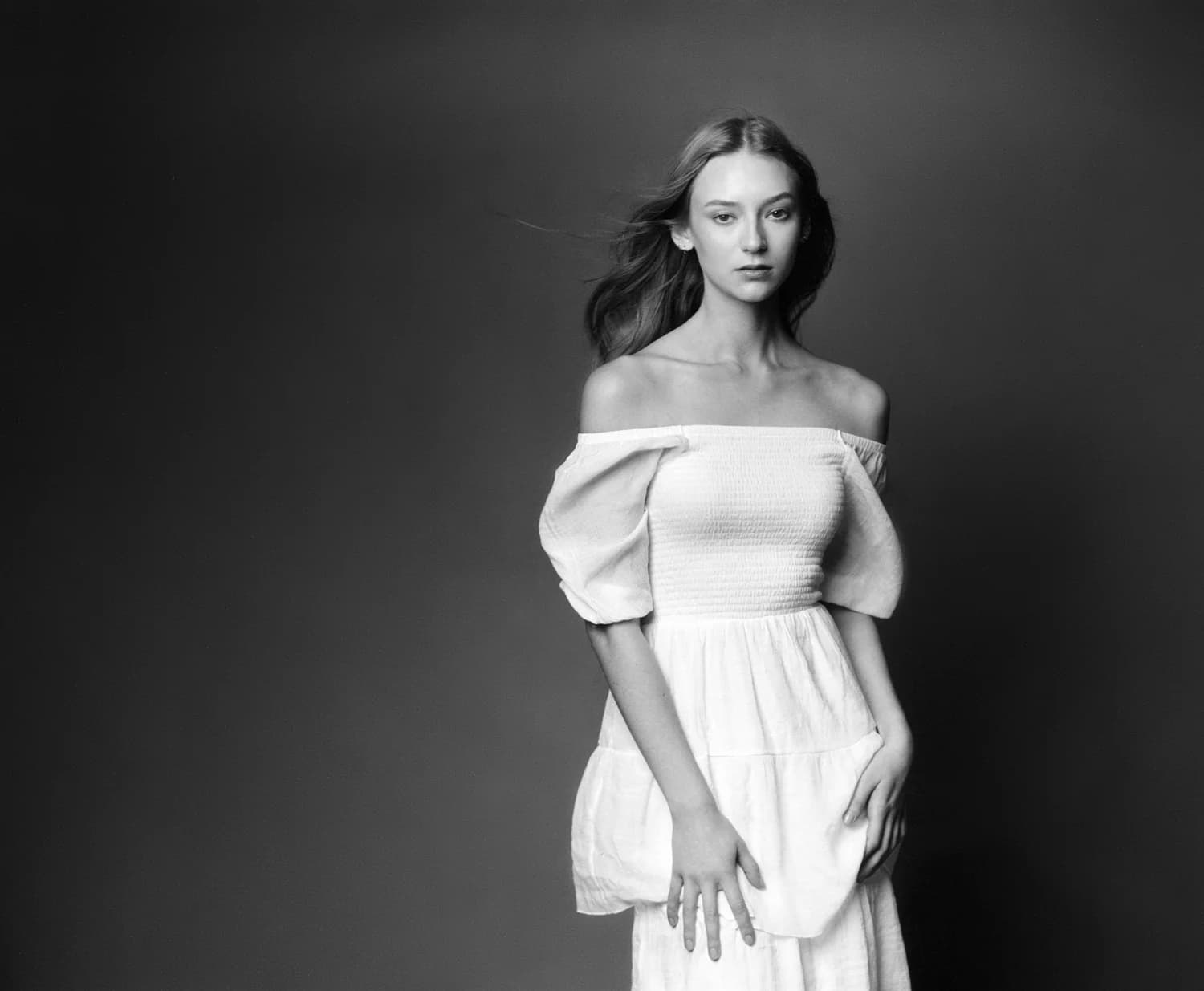
I shoot most of my client work on a Fujifilm GFX 100S II, a medium format digital camera that produces 102-megapixel files with absurd tonal range. It's fast and precise, and it can tether to a 32-inch monitor so clients see every frame in real time. It's the right tool for professional delivery. But every few months, I pull a different camera off the shelf: a 1970s Pentax 6x7, a mechanical beast that weighs about five pounds with the SMC Takumar 105mm f/2.4 attached. No autofocus. No light meter. No LCD screen. Ten frames per roll. I load it with Kodak Tri-X 400, one of the most iconic black-and-white film stocks ever manufactured, and I shoot fashion work that couldn't look more different from my digital output. This post is about a recent editorial session on that camera, and why I believe shooting film still matters, even in 2026.
Why I Keep Coming Back to the Pentax 6x7
The Pentax 6x7 was introduced in 1969. The version I shoot is from the early 1970s, fully mechanical, built like industrial equipment. The shutter sounds like a small car door closing. It's that loud and that physical. There's nothing digital about the experience. You focus manually through a waist-level finder or a pentaprism, meter the scene with a handheld Sekonic, set your aperture and shutter speed, compose carefully, and press the shutter once. Then you advance the film. You get ten frames on a roll of 120 film. Ten.
That constraint changes everything about how you work. On digital, I might shoot 200 frames in a 20-minute session and know I'll have dozens of keepers. On the Pentax, I shoot ten frames total and I need at least six of them to be usable. That ratio forces a level of intention that's hard to replicate when you have unlimited storage and instant review. Every frame costs roughly two dollars when you factor in the price of the film, development, and scanning. You don't waste a two-dollar frame on a test shot.
The 105mm f/2.4 lens is legendary for a reason. On the 6x7 format, which produces a negative roughly four times larger than 35mm, this lens creates a depth of field so shallow and a bokeh so smooth that it still holds up against any modern lens I own. The rendering has a three-dimensional quality that digital sensors struggle to replicate. Subjects pop out of the background with a separation that feels physical, almost sculptural.
The Shoot: Fashion on Tri-X 400
For this session, I wanted to explore high-contrast black-and-white fashion portraiture, the kind of work you'd see in early Richard Avedon or Peter Lindbergh editorials. Tri-X 400 was the obvious choice. It's a 400-speed black-and-white film with a grain structure that's simultaneously gritty and elegant. In medium format, the grain is present but fine, visible when you look closely, but never distracting. It adds texture to skin and fabric in a way that digital noise never does. Film grain is organic and random. Digital noise is patterned and ugly. Your eye knows the difference even if your brain can't explain why.
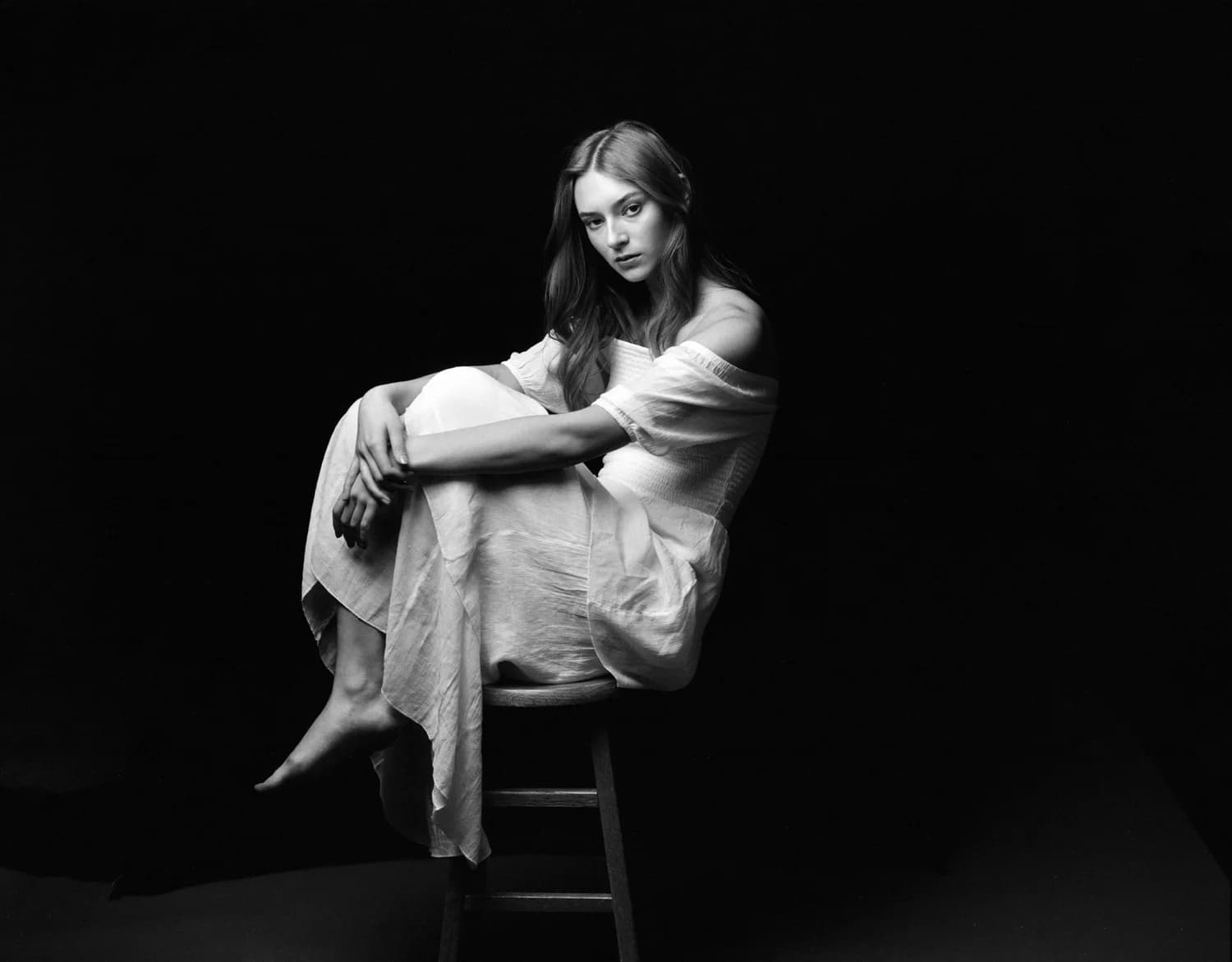
I set up a single large softbox, a 4x6 Elinchrom, positioned high and camera-left, angled down at roughly 45 degrees. One light. No fill. No reflector. I wanted hard shadows with a soft edge, the kind of dramatic falloff that Tri-X handles beautifully because it retains detail in the highlights while letting shadows go truly black. Digital cameras hold shadow detail aggressively, which is useful for corporate work but wrong for this aesthetic. I wanted black to be black.
The model changed through three looks over the course of two hours. I shot six rolls, sixty frames total. By digital standards, that's nothing. By film standards, that's a full editorial session.
What Tri-X 400 Actually Looks Like on Medium Format
Every film stock has a personality. Kodak Portra 400 is warm, forgiving, and flattering. It's the film equivalent of a good Instagram filter. Ilford HP5 is similar to Tri-X but slightly softer in contrast and finer in grain. Tri-X is neither warm nor soft. It's contrasty, punchy, and unforgiving. Skin texture is real. Fabric wrinkles are visible. Every shadow goes deep. Every highlight clips cleanly without muddiness.
On medium format, Tri-X has a tonal range that feels bigger than it does on 35mm. The larger negative captures more information per grain clump, so you get rich midtones alongside those punchy shadows and clean highlights. The result is an image that has both power and subtlety: dark blacks and bright whites connected by a smooth, detailed gradient in between. It's the reason fashion photographers in the 1960s and 70s shot on medium format Tri-X, and it's the reason the look hasn't been convincingly replicated digitally despite decades of effort.
I develop my Tri-X in D-76 at stock dilution, which gives a classic look: moderate grain, full tonal range, and reliable contrast. Pushing to 800 or 1600 increases grain dramatically and shifts the contrast curve, which can be interesting for editorial work but wasn't what I wanted for this session. I wanted the full Tri-X character without pushing it into experimental territory.
The Discipline of Ten Frames Per Roll
Here's what shooting ten frames per roll actually teaches you, and why I think every digital photographer should try it at least once.
First, you learn to pre-visualize. Before I press the shutter on the Pentax, I already know what the image should look like. I've evaluated the light, the pose, the expression, and the composition. If any of those elements aren't right, I don't shoot. I adjust and wait. On digital, the temptation is to fire and check: shoot a frame, look at the screen, adjust, shoot again. That's a valid workflow, but it trains you to react rather than plan. Film forces planning.
Second, you learn to trust your meter. Without an LCD showing you an instant histogram, you rely on your handheld meter and your understanding of the Sunny 16 rule and zone system. After enough rolls, metering becomes instinctive. I can look at a scene now and estimate the exposure within a third of a stop before touching the meter. That skill translates directly to my digital work. I set my lights faster because I understand light ratios intuitively, not just by chimping the back of the camera.
Third, you learn to direct with urgency. When every frame costs money and you only have ten of them, your direction to the model becomes precise. 'Turn your chin left a quarter inch. Drop your shoulder. Eyes here. Hold that.' No exploratory shooting. No 'let's just see what happens.' Every frame has a purpose. My digital client sessions are faster and more efficient because film taught me to commit to a direction before pressing the shutter.

Film vs. Digital: Why I Shoot Both
I'm not a film purist who thinks digital is soulless, and I'm not a digital evangelist who thinks film is obsolete. I shoot both because they do different things.
Digital is the right tool for client delivery. Tethered shooting, instant review, unlimited frames, consistent color, and fast turnaround. These aren't luxuries for commercial work; they're requirements. When a law firm needs 50 headshots in a day with fast turnaround, film isn't an option. When a marketing team needs to review images in real time during a lifestyle shoot, film can't do that. My GFX system exists because my clients need speed, consistency, and volume.
Film is the right tool for creative exploration and intentional personal work. It slows me down in a way that makes me better. The images have a physical quality (real grain, real tonal curves, real chemical rendering) that digital emulations approximate but never duplicate. I've tested every major film emulation plugin, including Dehancer, which I use and recommend for digital work. They're excellent. They're not the same as real film. The difference is subtle enough that most viewers won't notice, but I notice, and it matters to me as the person making the image.
The Pentax 6x7 also keeps my relationship with photography honest. After a week of shooting 50-person corporate headshot days, the Pentax reminds me why I picked up a camera in the first place. It's slow, physical, and demanding. There's no safety net. You either nail the frame or you don't. That pressure is exactly why the results feel different.
Want editorial portraits with this kind of intention?
Whether digital or film, I bring the same deliberate approach to every session. Tell me what you want the portraits to be used for.
Get a QuoteWhat This Means for My Client Work
Every editorial session I shoot on the Pentax makes my digital work better. The discipline of pre-visualization translates to faster, more decisive shooting on client sessions. The understanding of light that comes from working without an LCD transfers to more intentional lighting setups. The compositional precision demanded by ten frames per roll carries into digital work where I have thousands of frames available but approach each one as if it counts.
Clients sometimes ask if I can shoot their session on film. The answer is yes, with caveats. Film sessions take longer, cost more (the film and processing alone run several hundred dollars per session), and don't allow for tethered review. But for clients who want something genuinely different, a personal branding shoot with real film character, a portrait session with a tactile quality that digital can't replicate, it's a conversation worth having.
The Pentax 6x7 and a few rolls of Tri-X remain my favorite way to shoot when the brief allows it. Not because film is better than digital. Because the process of shooting film makes me a better photographer when I pick up my digital camera the next morning. The film work is a personal project. The day job is corporate headshot work for St. Louis companies.